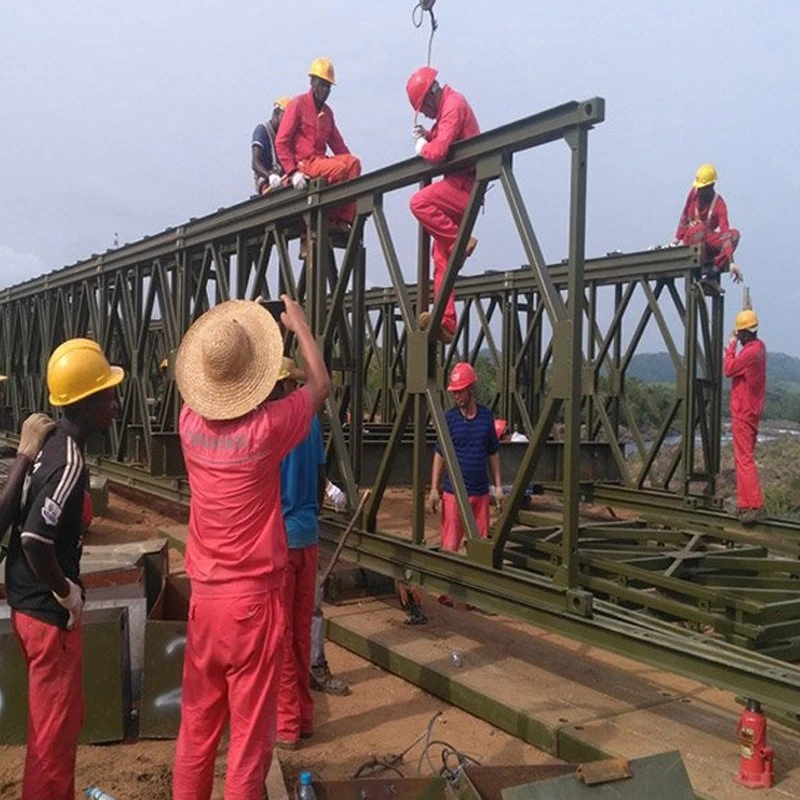

Installation and Structural Formation Acceptance of Bailey Steel Bridges
Nov 13, 2026
Leave a message
Installation and Structural Formation Acceptance: Controlling Cumulative Deviations
Compliant components do not necessarily ensure structural safety; assembly accuracy and overall alignment must also be verified.
Control Points for Assembly and Connections:
After assembly, the verticality deviation of the Bailey truss shall be ≤2 mm/m, and the axis position deviation shall be ≤10 mm.
The spacing deviation between adjacent Bailey panels shall be ≤5 mm.
The pin tightening torque shall be controlled in accordance with the scheme (common reference value: 50 ± 5 N·m), and the pin insertion depth shall reach at least 90% of the hole depth.
After the Bailey pins are installed, safety pins must be fitted to prevent them from falling out due to vibration.
Foundations and Bearings: The bearing capacity of the foundation shall meet the design requirements, and static load tests shall be carried out when necessary. The elevation error of the foundation top surface shall be ≤±5 mm, and the horizontal error of the bearing top surface shall be ≤2 mm/m. Bailey bridges are relatively sensitive to differential settlement; the relative settlement difference between adjacent supports should preferably be controlled within L/600 (L is the distance between adjacent supports).
Overall Deformation: After formation, the maximum allowable deflection is generally controlled at ≤L/500 (L is the span), and the horizontal displacement shall be ≤20 mm. For temporary bridges with heavy loads or higher requirements, the deflection control criteria may be stricter , and the design documents shall prevail.